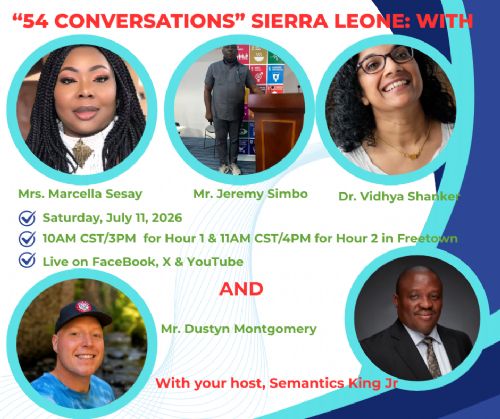
Sierra Leone's constitutional amendment bill is being negotiated without the citizens it will govern, two of the country's most prominent accountability advocates said on The Africa Desk Live on July 11, and the time to fix that is running short.
Marcella Samba-Sesay, executive director of the Campaign for Good Governance, marked her organization's 30th anniversary on July 1 by recalling its origins. It was founded in 1996, at the height of the civil conflict, by a pro-democracy movement that demanded elections before peace.
"Our democracy was not given on a silver platter," she said. "Citizens fought for it, and lives were lost."
After the contested 2023 elections, a committee of the government, the main opposition All People's Congress and the international community was convened, and a constitutional amendment bill drawn from its recommendations now sits before Parliament. Samba-Sesay's objection is about who was missing from the room. When the bill was first laid in January, she said, civil society pressed the Attorney General to reopen it and submitted position papers. Whether they will shape the final text remains unresolved.
The deadline is real. Sierra Leone holds presidential, parliamentary and local elections on a single day, with the next vote in 2028, and ECOWAS standards call for changes to the legal framework to be complete at least six months before polling.
Appointments and allegiance
Jeremy Simbo, executive director of the Center for Accountability and Rule of Law, joined the program after traveling out of Freetown to find a strong enough signal. He described a system in which the President appoints the Inspector General of Police, the Chief Justice and the Electoral Commissioner.
"Imagine somebody who appoints you, somebody who has the responsibility to hire and fire you," he said. "Your allegiance will rest with the person who appoints you."
Constitutional review has now run for roughly two decades, Simbo noted, beginning as a recommendation of the Truth and Reconciliation Commission. An 80-member committee under the late Justice Cowan produced a report of more than 600 pages. The government accepted 50 of its recommendations and rejected the rest, Simbo said, and civil society wants that report revisited rather than a narrower amendment.
Both guests described personal costs. Simbo said he received hundreds of calls, some threatening his life, after his organization questioned the management of the national social security scheme. Samba-Sesay said 20 years of consistent positions had recently been recast as opposition partisanship, and she dared anyone to produce her party card.
"Poverty knows no party. Poverty knows no face. Poverty knows no tribe," she said. "When you are poor, you are poor."
In the second hour, Dustyn Montgomery of the Sierra Leone Foundation for New Democracy described the foundation's work rooted in permaculture and village opportunity, and a 2024 walk from Monrovia into Sierra Leone with 30 young Sierra Leoneans.
The Africa Desk Live airs every Saturday from 10:00 AM to 12:00 PM Central on Facebook, YouTube and X, and at moremediaempowerment.org/live.